A workflow-led platform for NHS practices, PCNs and ICBs. Identify data quality gaps, activate weight-management pathways, review GLP-1/tirzepatide opportunity, prioritise high-need patients and surface safety/caution cohorts — all from one structured workspace.
Practices, PCNs and ICBs are not short of obesity data — they are short of usable pathway intelligence. Static prevalence reporting cannot drive the structured action needed across data quality, weight-management pathways, GLP-1/tirzepatide review, prioritisation and safety.
Obesity now intersects with diabetes, cardiovascular disease, sleep apnoea, fatty liver, mental health and inequalities — driving avoidable demand across the NHS.
Effective obesity care needs sequencing across coding, advice, referral, pharmacotherapy review and safety — not single-step prescribing or a static register.
NICE TA1026 and NHS England interim commissioning guidance make pharmacotherapy pathway review a live operational need — not just a prescribing decision.
Deprivation, comorbidity burden and clinical complexity vary widely. Teams need clear ways to surface higher-need cohorts so finite capacity is used fairly.
Practices waste time stitching together saved searches and spreadsheets. They need ready-made worklists with cohort context, recommendation and status tracking.
Networks and systems need consistent visibility across practices — for variation, deprivation, capacity planning and pathway commissioning.
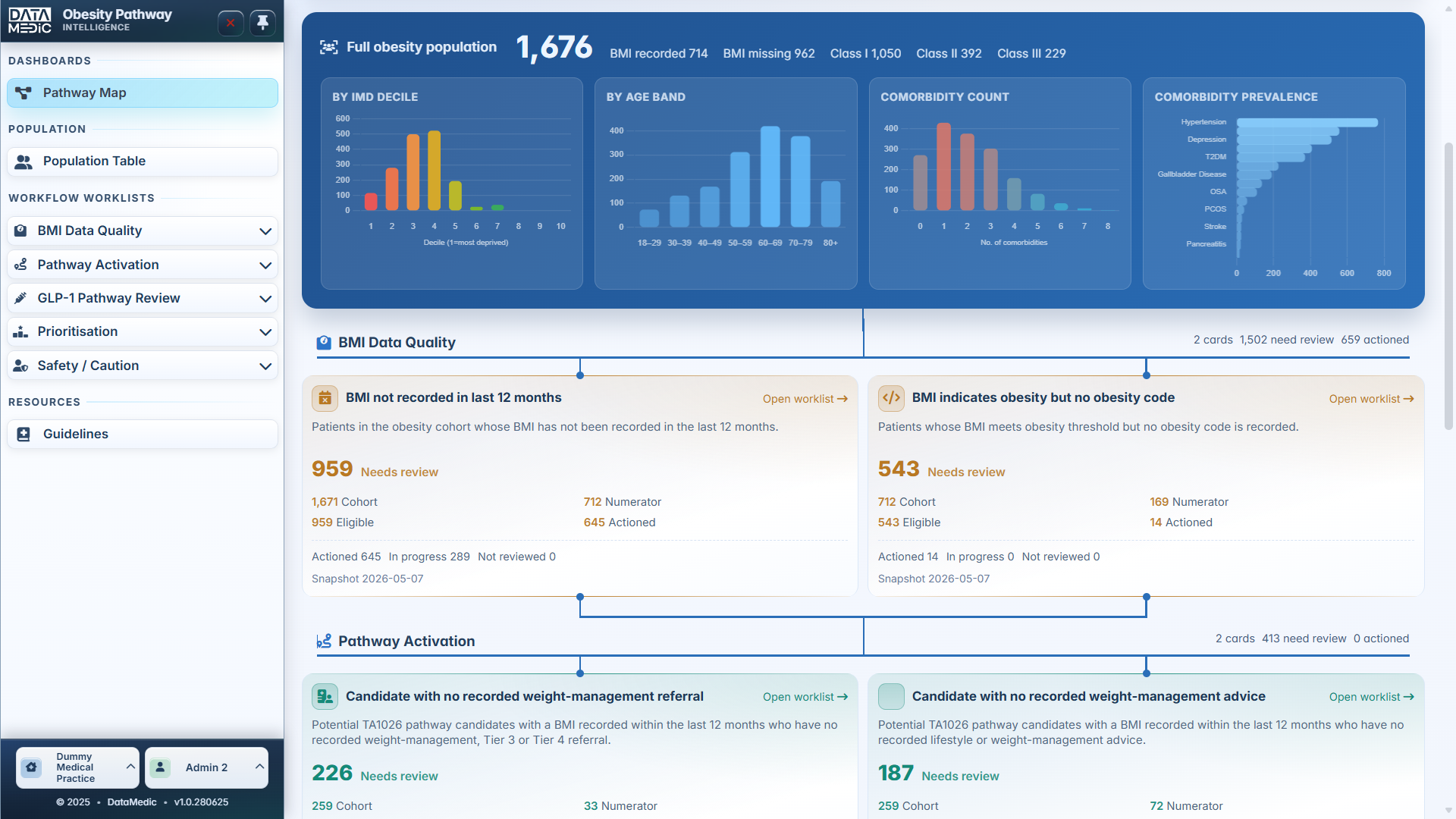
A single consolidated obesity population, branched into the five pathway modules NHS teams actually work through — with example cohorts surfaced as patient-level worklists.
One consolidated view of patients with obesity and relevant clinical, demographic and pathway markers.
Rebuild a clean foundation: recent BMI, accurate obesity coding, validated population.
Surface candidates whose pathway has not been activated through advice or referral.
Review pharmacotherapy pathway opportunity against NICE TA1026 and phased access criteria.
Use deprivation, comorbidity load and risk markers to focus capacity on higher-need cohorts.
Surface medication-context and clinical caution groups for structured review.
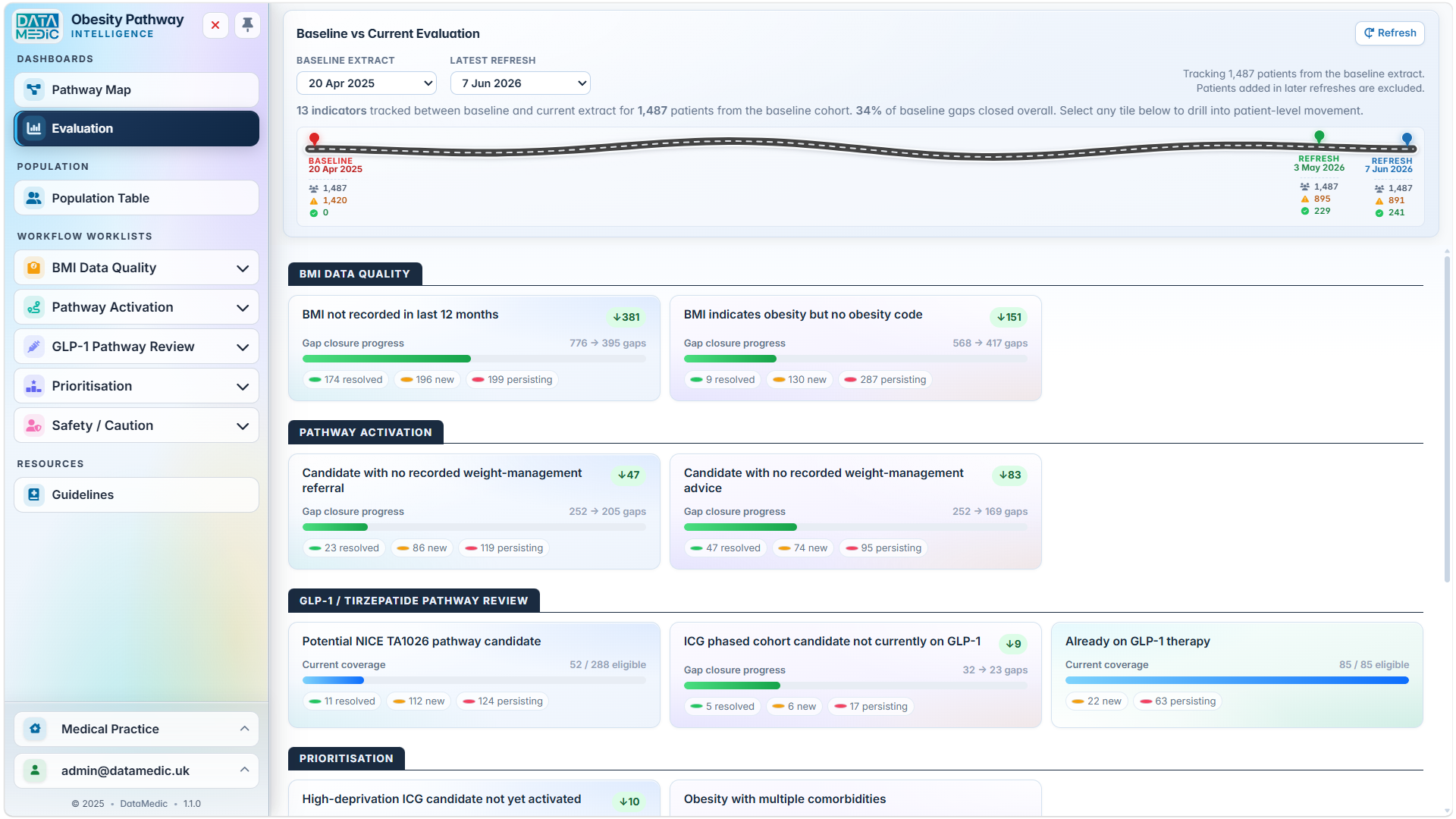
Five core surfaces that move teams from population intelligence to operational pathway action — click through each below.
See how the obesity population flows through data quality, activation, GLP-1/tirzepatide review, prioritisation and safety, with cohort counts at every stage.
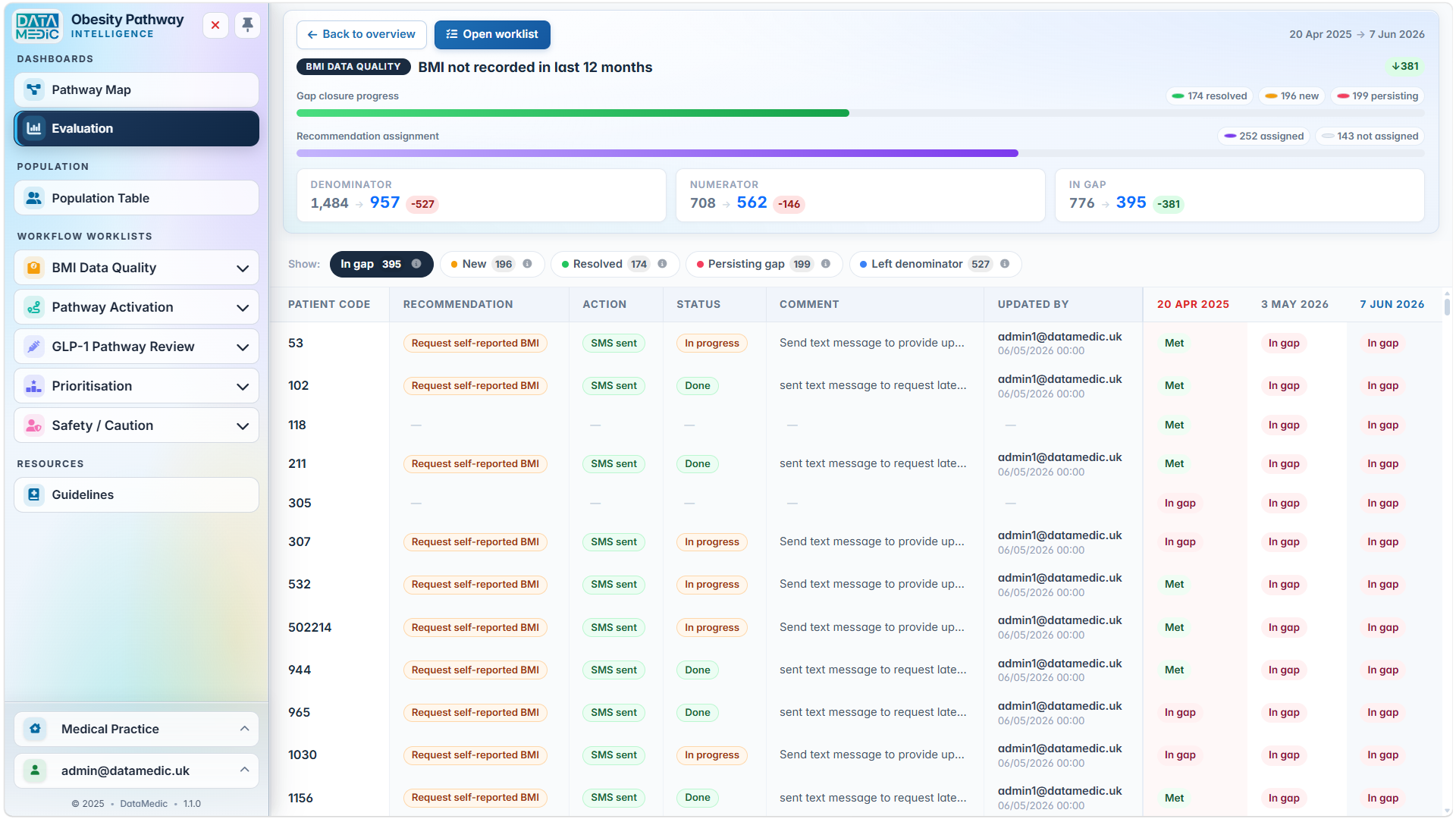
Each insight opens as an operational review list with cohort context, clinical detail and recommendation tracking — ready for MDT or pharmacist-led review.
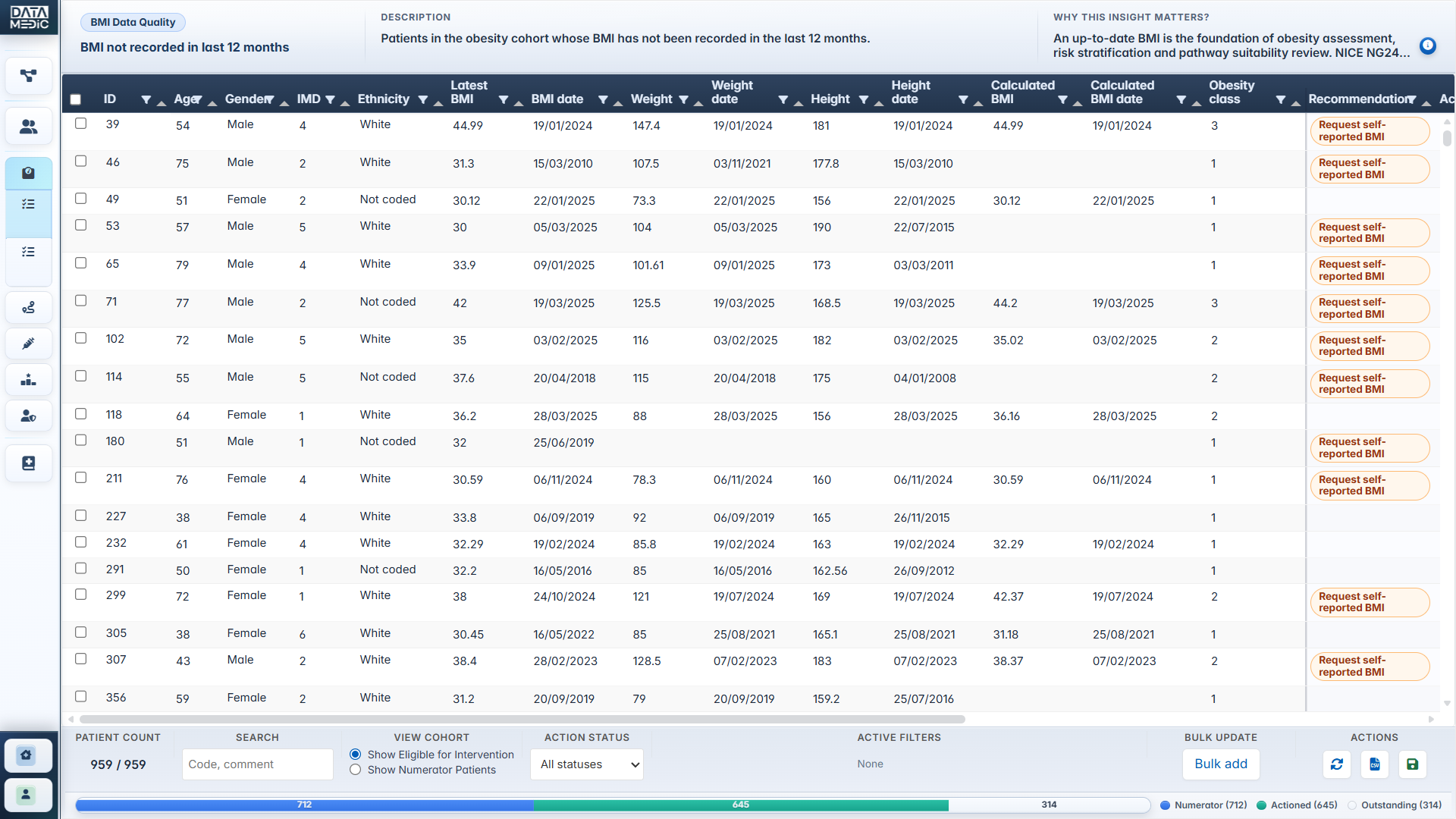
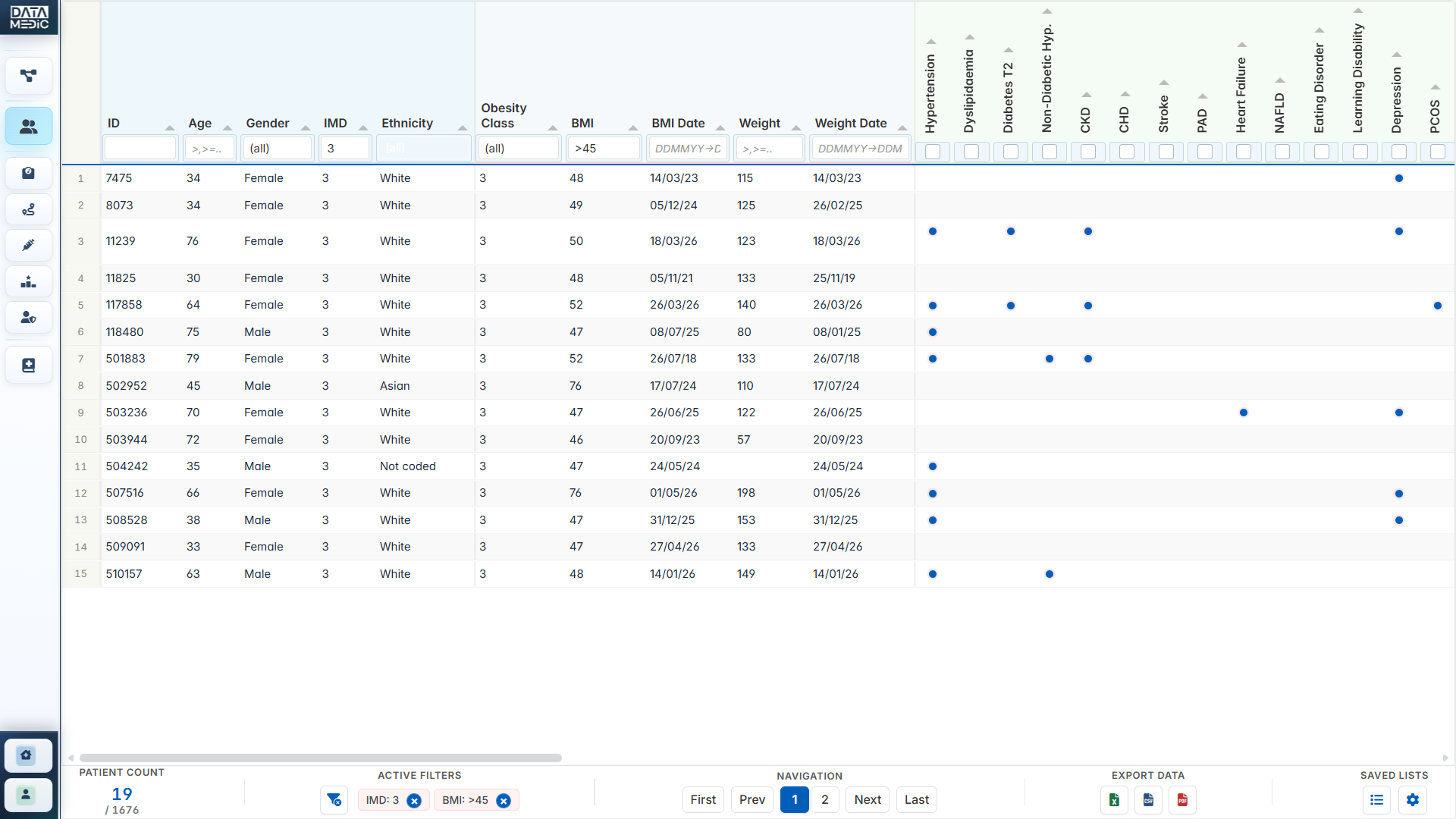
BMI, weight, comorbidities, medications, pathology and pathway markers in one explorable table — for validation, segmentation and local planning.
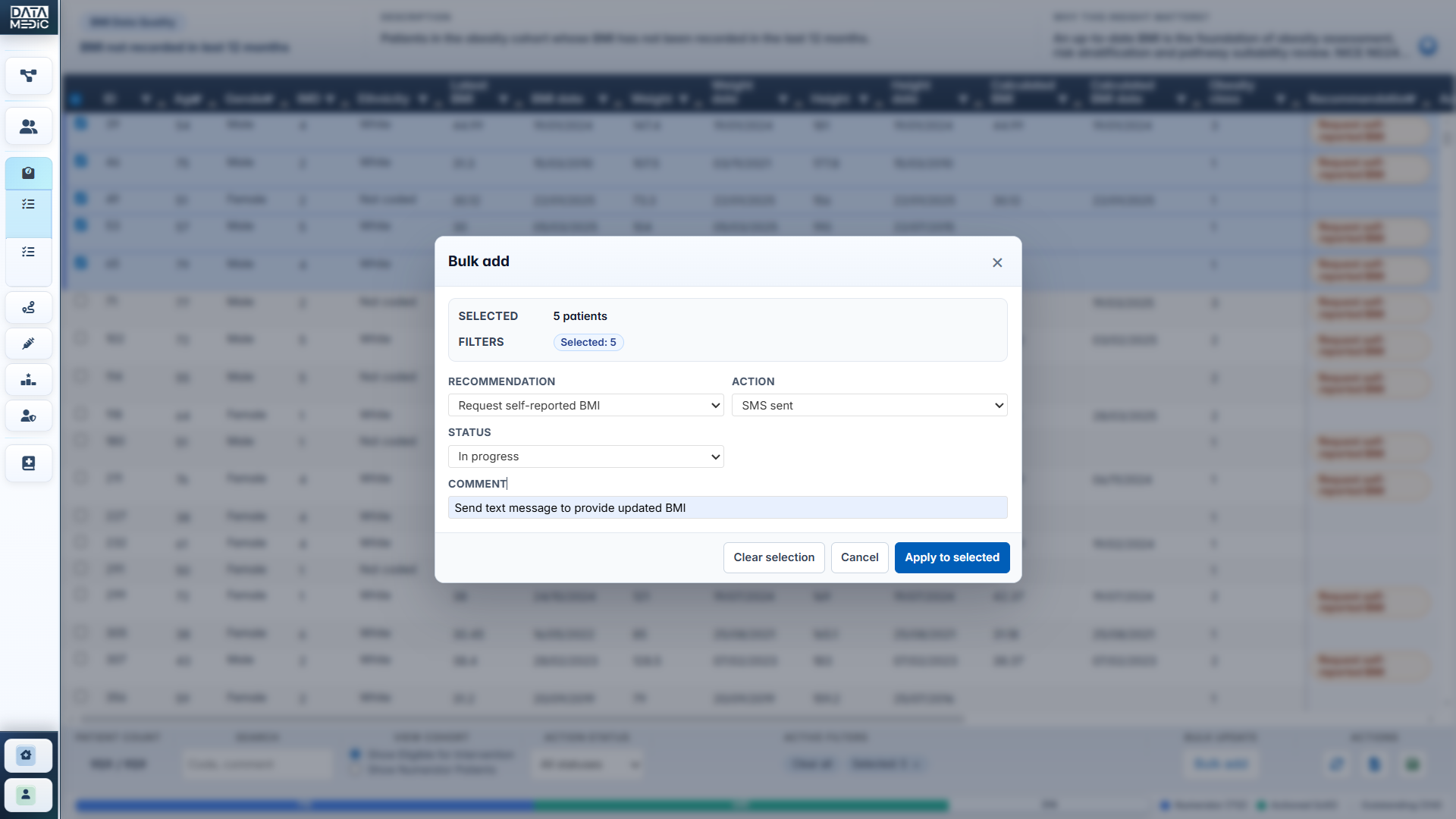
Apply recommendations and statuses across selected cohorts to drive consistent team workflow at practice and PCN scale.
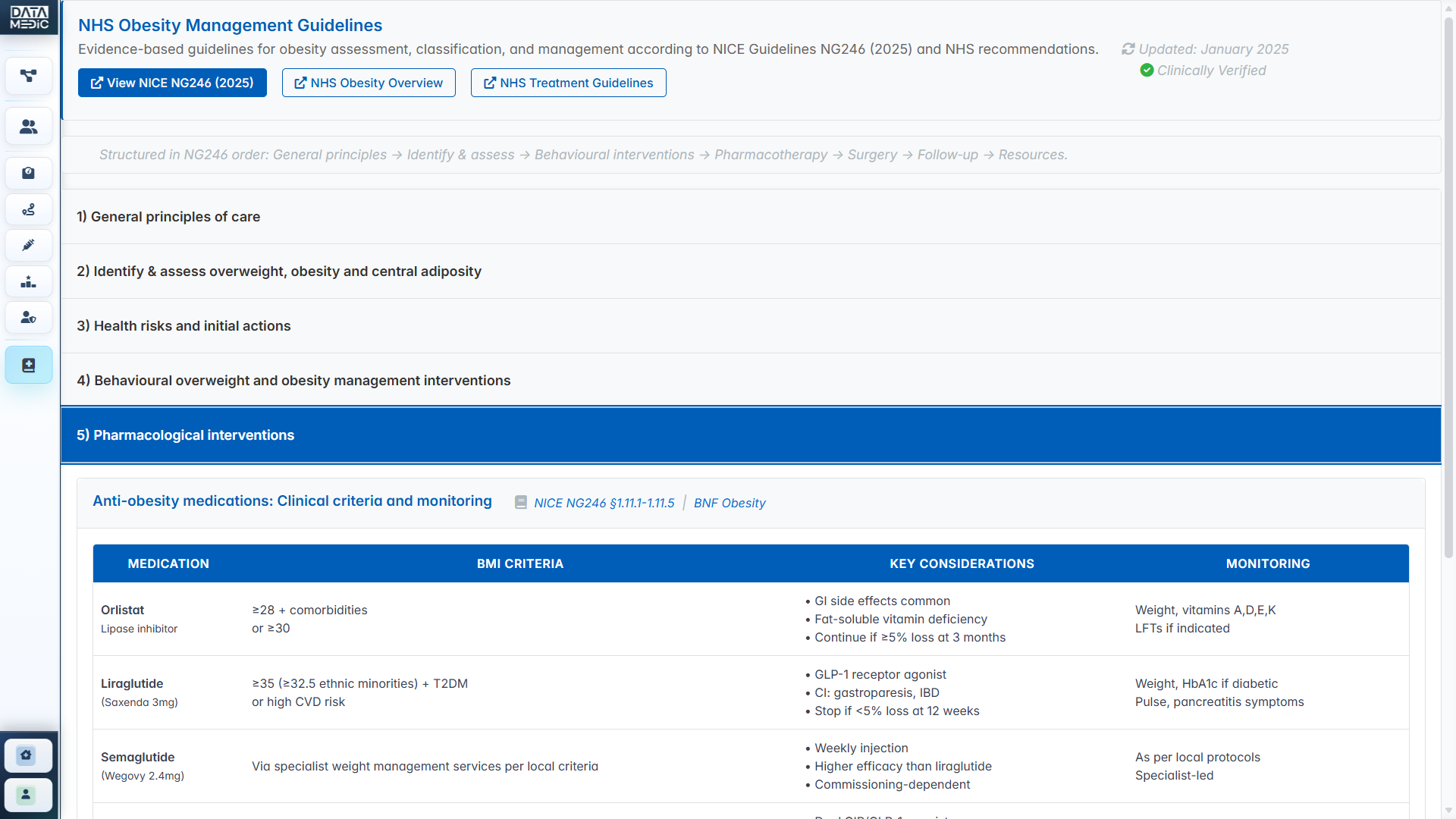
Built-in NICE and NHS guidance, clinical rationale and interpretation notes keep pathway decisions grounded in current best practice.
Six structured capabilities that turn obesity population data into a managed pathway workflow, not just a static dashboard.
Visualise the full obesity population segmented across data quality, activation, pharmacotherapy review, prioritisation and safety.
Open each insight as a patient-level worklist with recommendation, action and status tracking for clinical and admin teams.
Explore BMI, weight, comorbidities, medications, pathology and pathway markers in one structured population table.
Identify patients who may need review against NICE TA1026 broad criteria and NHS England phased access cohorts.
Surface deprivation and comorbidity-based priority groups to support equitable obesity pathway planning at scale.
Highlight medication-context and clinical caution groups (e.g. GLP-1 + DPP4) for structured review and governance support.
Practical value at every level of the system — from the GP practice clinical team, to the PCN coordinating delivery, to the ICB planning at population scale.
Common, practical scenarios — from data quality recovery to safe deployment of pharmacotherapy pathways.
Surface obesity-coded patients without a BMI in the last 12 months for recall and review.
Identify patients whose BMI suggests obesity but who have no obesity code recorded.
Identify candidates without recorded advice or referral and prepare review lists for action.
Surface ICG phased-access candidates and broad TA1026 review groups not currently on therapy.
Focus capacity on higher-need cohorts to support equitable rollout and pathway planning.
Highlight GLP-1 + DPP4, GLP-1 + insulin/SU and pancreatitis/gallbladder caution groups for structured review.
Designed around structured data extracts and refreshed insight snapshots. Supports clinical review and pathway planning — it does not write back to clinical systems or replace clinician decisions.
Practice data extracts are securely imported and structured for obesity pathway analysis.
Pathway logic is applied to produce structured patient-level cohorts and refreshed insight snapshots.
Teams use the Pathway Map, worklists and population view to prioritise pathway action.
Recommendations, actions and statuses are captured in the platform to support team workflow.
Built by a team with deep experience of NHS primary care data, EMIS Web and SystmOne extract workflows, SNOMED-led clinical definitions and structured insight delivery.
Built around the realities of practice data, registers, coding and pathway delivery.
Structured data extract workflows, no need for live write-back into clinical systems.
Clinical cohorts built on terminology and methodology designed for NHS use.
Operates in line with NHS data security expectations. Clinical review support — not automated prescribing.
The platform supports practice-level adoption, PCN/ICB pathway models and governance-compliant service-enablement programmes — aligned to NHS expectations and local approvals.
Three common deployment patterns — designed to fit how NHS organisations actually plan, fund and manage obesity pathway delivery.
Whether you are a practice looking for actionable worklists, a PCN coordinating pathway delivery, or an ICB planning obesity services at scale — Obesity Pathway Intelligence helps turn population data into structured pathway action.