Disease-specific logic
Each platform is built around the clinical rules that matter for that area, including SNOMED codes, disease registers, QOF indicators, prescribing markers, pathology results and pathway criteria.
DataMedic clinical platforms turn structured EMIS Web and SystmOne data extracts into disease-specific dashboards, actionable patient cohorts and patient-level review lists for GP practices, PCNs and ICBs.
Built around SNOMED-led clinical logic, QOF business rules, disease registers and practical NHS primary care workflows.
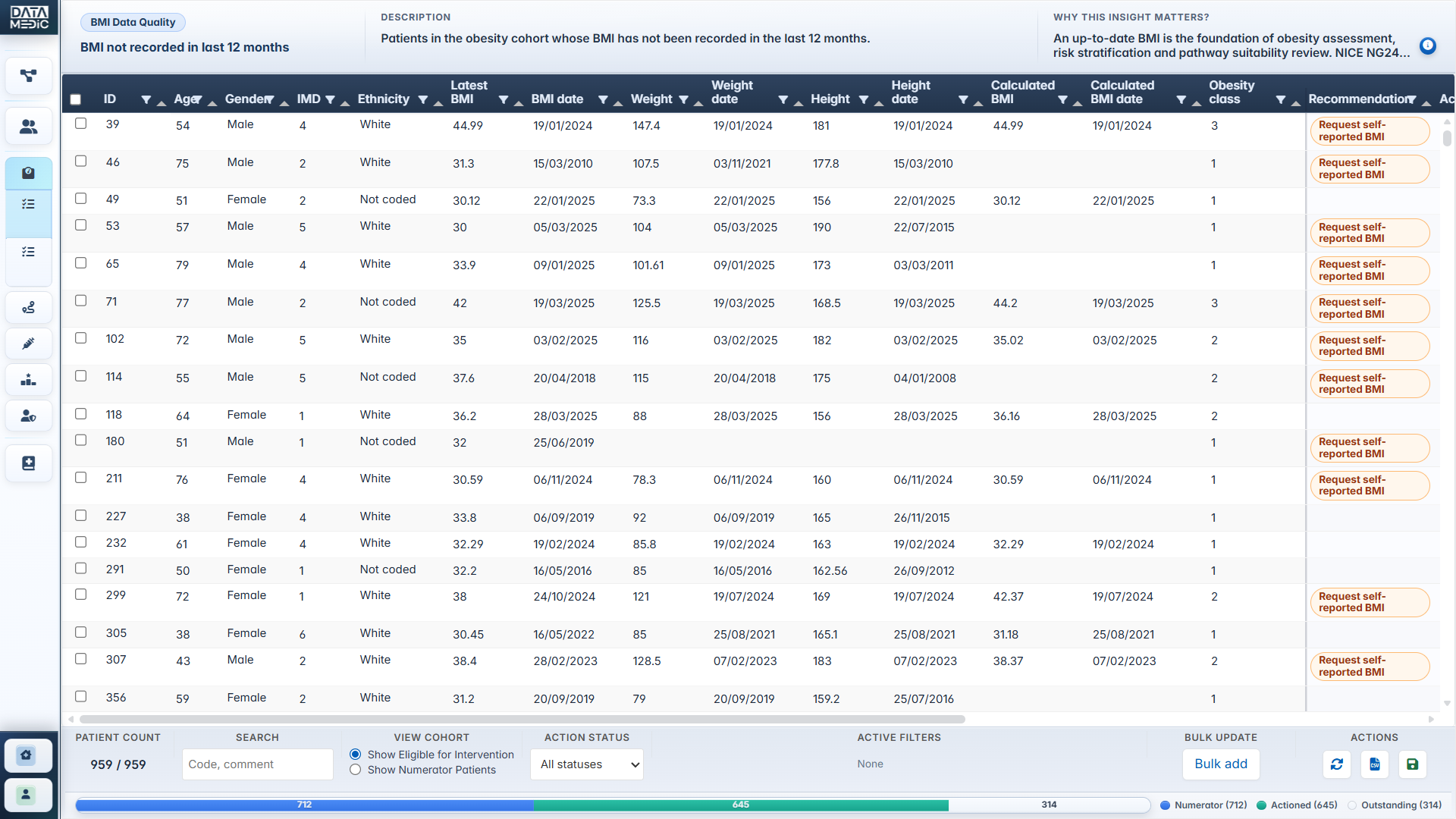
A DataMedic clinical platform is a disease-specific digital workspace that helps primary care teams understand their population, identify care gaps and act on patient-level insight. Each platform combines clinical coding, disease registers, QOF logic, pathology, prescribing and demographic data into a clear dashboard and review workflow.
Each platform is built around the clinical rules that matter for that area, including SNOMED codes, disease registers, QOF indicators, prescribing markers, pathology results and pathway criteria.
Dashboards do not stop at charts. Each insight links to actionable patient cohorts and review lists that support coding checks, recall, pharmacist review and local pathway activity.
Data can be refreshed over time so teams can monitor progress, see which gaps remain and focus effort where it is most needed.
Every DataMedic clinical platform follows the same core structure, so teams know where to find overview metrics, practice-level insight, patient cohorts and full population data.
High-level prevalence, activity and benchmark metrics for the selected disease area, with views suitable for practice, PCN and ICB-level monitoring.
Charts and summary metrics that help teams understand the disease population within a practice or network.
Focused insight sections that identify specific patient cohorts requiring review, follow-up or local action.
A patient-level table containing relevant clinical, demographic, pathology and prescribing markers for the disease area.
Clinical context and pathway notes that help users understand why each cohort matters and how it links to local or national priorities.
Practices run structured searches or exports from EMIS Web or SystmOne using agreed data specifications.
DataMedic applies SNOMED-led definitions, clinical marker logic, QOF rules and pathway-specific criteria.
Patients are grouped into meaningful cohorts such as missing coding, overdue monitoring, uncontrolled risk or review opportunity.
Teams use patient-level review lists to support local action, then refresh data to monitor progress and remaining gaps.
DataMedic supports clinical review and operational prioritisation. It does not replace clinician judgement or automatically update patient records.
The same platform model can be applied across different disease and therapy areas, with the clinical content tailored to each pathway.
Supports obesity population management, BMI data quality, pathway prioritisation, GLP-1/tirzepatide review, safety cohorts and patient-level workflow.
View Obesity PlatformBeing rebuilt for NHS QOF and business rules 2026/27. Previously supported QOF-aligned CVD prevention insight, cholesterol indicators, hypertension markers, diabetes-related CVD prevention, smoking and stroke/TIA pathway opportunities.
View update statusA broader platform for care gaps, missed diagnoses, overdue monitoring, inequalities and targeted review across practice, PCN and ICB populations.
Explore Population HealthThe DataMedic platform model can be extended into diabetes, respiratory care, CKD, heart failure, atrial fibrillation, prescribing optimisation and other priority areas.
Discuss a New PlatformIdentify patients who are missing from registers, overdue for monitoring, uncontrolled against targets or suitable for structured review.
Coordinate delivery across member practices, compare variation, support DES/QOF priorities and manage pathway work at network level.
Understand population-level need, variation, inequalities and pathway gaps across primary care, supporting commissioning and improvement planning.
Clinical platforms can also support NHS-facing pathway improvement programmes funded or supported by responsible life sciences partners, subject to appropriate governance and local approval.
DataMedic is designed for the realities of NHS primary care data, not generic business intelligence.
We understand primary care pathways, long-term condition management, QOF, coding and the practical pressures faced by GP teams.
Platforms are designed around the structured extract workflows used by practices, rather than assuming unrealistic live integration.
Cohort definitions can be built around coded clinical logic, SNOMED concepts, PCD refsets and disease-specific markers.
The platform connects high-level dashboards to patient-level review lists and action tracking.
The same model can work at practice, PCN and ICB level.
Built with role-based access, data minimisation and information governance expectations in mind.
Whether you want to support QOF delivery, identify care gaps, support a PCN pathway or develop an NHS-facing programme, DataMedic can help turn primary care data into structured clinical action.
We typically reply within one business day